Monday, August 27, 2012

End of Summer Season Highlights

When the Cicadas start buzzing, it's near the end of the breeding season for birds in our area. This summer has been unusually dry and berry production appears to be low for the early fruitbearers such as raspberries. These fruit producers provide food for many fledgling birds along with the bounty of insects in the marsh. Orioles, Yellow Warblers (YEWA), and Prothonotary Warblers (PROW) as well as Purple Martins (PUMA) and swallows are staging in the marsh region right now. Where they all come from is a mystrey but includes locally raised birds as well as dispersal and reverse migrants coming to the ample and dependable food base near the lake.

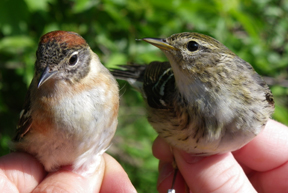
 Flycatchers are one of the first to begin the southerly journey each fall. Here are a couple species to compare bill size and color. Notice the dark bill on the Eastern Phoebe (EAPH). However, you can still see the remains of its fleshy gape in the corners of its bill and the inside of its mouth is orange instead of the black as in an adult matching the bill color.
Traill's Flycatcher (TRFL) left and Eastern Phoebe (EAPH) right

TRFL arrows point to rictal bristles which aid in fly catching and buffy wing bars which signify a hatching year flycatcher.
 Some additional highlights of the summer are as follows. Please enjoy.

Blue Grosbeak (BLGR) female-note bi-colored bill

Female BLGR

Male Eastern Bluebird (EABL)
Lark Sparrow (LASP)-note beak, it has been eating berries

LASP-had a brood patch-both sexes appear similar(Note tail markings)
Tufted Titmouse (TUTI)- Hatching Year bird with its yellow gape at base of bill

TUTI with tuft

To gear up for the fall let's add a Quiz Bird!  Here is one for you:

Quiz answer below.

By the end of August YEWAs, orioles, PROWs, and most flycatchers will have migrated south. Sometimes we can get a YEWA later in fall, but that is often an Alaskan bird showing larger size and a greenish cast to the feathers. Enjoy the fall season which is full of confusing fall warblers. They are a puzzle in their migration patterns as well as with their feather patterns. Get set for a great season!
Quiz Answer: Yellow Warbler with its yellow tail spots and all yellow plumage.

Thursday, July 12, 2012

Summer, Summer, Summer...Birds!

While summer is a slower time for migration researchers, it is not for the birds who are raising young. Here are a few of the youngsters we have encountered during our summer banding sessions at Navarre, Oak Openings, and West Sister Island.

Hatching Year (HY)  Tree Swallow (TRES)
Most young will have loose juvenile feathers and remnants of a yellow gape around the hinge of their beaks.
 Hatching Year male Downy Woodpecker (DOWO)
HY Carolina Wren

Quiz bird from Oak Openings


Breeding bird studies are not without heat, bugs, and other challenges, but we have great volunteers who do not seem to mind the "not so pretty" jobs. Thanks for all you do!
Tom helps at Oak Openings and doesn't mind the heat.
Nor does the Viceroy who loves the salts on his hat!

Kelly does not mind the smelly job of banding herons and egrets on West Sister Island.

Mike also is in the spotlight with this Great Egret (GREG) chick on West Sister Island.

No one can deny that young birds may only be considered cute by their parents. What do you think of this Black-crowned Night-Heron (BCNH) chick?

Take time to notice the hatching year birds at your feeder or in your backyard. They look a little funny with their loose fluffy feathers, and usually act a little funny as well. 

Now about that quiz bird: It's a HY Lark Sparrow. The very short tail which is just growing in gives this one away, but HY sparrows can be a handful to ID.


Enjoy the beauty of the season!

Wednesday, May 30, 2012

Third Wave birds are here!

The third wave of migrants has arrived. The wave of the Empidonax Flycatchers and vireos. Mourning (MOWA), American Redstart (AMRE), Female Magnolia (MAWA), Canada (CAWA), Wilson's (WIWA), and Connecticut Warblers (CONW) will round out this wave. Yellow-billed (YBCU) and Black-billed Cuckoos (BBCU) will peak their migration for spring. They always seem to provide the grand finale for the season, bringing up the end with a flash of their tails! 

Philadelphia Vireo
We have had several days this week May 21st - 28th of double digit Philadelphia Vireos (PHVI). What a nice vireo to see in good numbers. Just two years ago, we captured only one the whole season! It demonstrates the importance of long-term monitoring as one year alone will not solve the puzzle of migration and a species population. If there was subsequent years of lower numbers then a closer look would be required.

Second year male SCTA


A highlight of the week was this male Scarlet Tanager (SCTA). There had been two singing for several days but too high to be caught in our mist nets which are 8 feet high. Notice the primary coverts are dull brown which makes this a second-year male hatched last summer. You can see remnants of his winter/basic plumage of the lime green feathers.

Female warblers can have their subtle beauty. Take a look:
Bay-breasted and Blackpoll Warbler females

Bay-breasted Warbler female back
CONW-female

MOWA- Adult female-note yellow throat and unusual black feathers.


We had the opportunity to show off the flycatcher group this week:

Can you ID these flycatchers?
Here are two of them, frontal view.


 Answers found at the end.


Here is a real treat - an Olive-sided Flycatcher (OSFL)


OSFL- note the large bill and gray vest it is sporting.


Eastern Wood-Pewee (EAWP)- note the crest (not often seen)


 Eastern Wood-Pewee (EAWP), Yellow-bellied Flycatcher (YBFL), Traill's Flycatcher (TRFL), Great-crested Flycatcher (GCFL), and Olive-sided Flycatcher (OSFL).
 
 
The end of migration may only be days away but the cuckoos will be here to sing their song.  This is the time we look forward to the great breeding birds we have in our backyards! Thanks for all you do to allow some of these long distance migrants to nest successfully in your neighborhood. With banding data we know many birds return to their natal area to breed. Females have high site fidelity. We have caught 57 Yellow Warblers (YEWA) banded in previous years.  To see other species returning go to BSBO research pages http://www.bsbo.org/passerine/pdf/passerinebandspringnavarre.pdf Enjoy the beauty of the season!

All Empidonax flycatchers have wing bars, eye-rings and bi-colored bills. Answer to left photo quiz :Two YBFLs (left and center) and Acadian Flycatcher (ACFL) on right. Bird bellies photo shows ACFL on left and YBFL on right. YBFL has a dark green throat and belly and orangish bill and ACFL has lighter belly and throat and really pale lower mandible.