Sunday, November 27, 2011

Fall 2011 Highlights

The fall migration had a slow start in August and September at the Navarre Banding Station; however, by the time October rolled around, migration kicked in, and the station recorded numbers above average. This followed a record spring banding total. The tremendous effort of day-in-day out migration monitoring could not be conducted at the Navarre Marsh station without the great help and time given by the Observatory's volunteers. Thank you for all you do!
Mary Lou with her signature bird (Brown Thrasher)

The Sunday crew of Marlene, Jay, and Mark 

Deb and Julie helping at the mist net
(There is a mist net between the two ladies, but it's hard to see)
John and others like him are always fixing our equipment

The grand highlight(s) of the fall season comes with the recapture of six Blackpoll Warblers (BLPW), that we had banded in previous years. The oldest was at least six years old and still flying! Yes, at least 6 times this bird has made the trip down and back from Venezuala/Brazil to the boreal forests of Canada. The other five birds were banded in these years: 2007, 2008, 2009, 2010 (2)


BLPW- Fall Plumage

One of the greatest rewards of bird banding is learning more about their life history. BSBO's research documents that stopover habitats in the Lake Erie Marshes are important for the Blackpoll Warbler (and so many other migrant birds) each fall. This year, the weather must have been just right and a vast representative of the world Blackpoll population dropped into the small area of NW Ohio that we call home. BSBO uses this information to raise awareness of the value of stopover for migratory birds and to build local, regional, and national support for habitat conservation. If you would like to support the research and conservation efforts of Black Swamp Bird Observatory, please visit the BSBO WEBSITE for ways that you can help.

The highlight of the last day of station operations and
the feathered harbinger of winter...
American Tree Sparrow (ATSP)
With winter around the corner, just remember that spring is at the next bend. For some it is resignation, for some a welcome anticipation. But winter is a part of Ohio's seasons and there are still birds to search out and admire at your feeders or nearby parks. Some of these do not get the attention they deserve. So here they are for you to enjoy.
Male Northern Cardinal (NOCA)

White-throated Sparrow (WTSP)


Carolina Wren (CARW)


CARW back-notice long bill and distinctive eye stripe

Hermit Thrush (HETH)- a short-distance migrant. Some stay around in winter.

Take time to enjoy the birds and consider the fantastic journeys they have made and what it takes for them to make those journeys.

Monday, October 24, 2011

October Birds Linger Despite Monsoon-like Conditions

Despite the monsoon-ish weather and strong Northeast winds of this past week, we did manage to get out a couple days to document late fall migration. There are still lots of White-throated Sparrows (WTSP), Song Sparrows (SOSP), and Hermit Thrushes (HETH) following the front in the marsh region. Banded Blackpoll Warblers (BLPW) are still being captured and are adding fat reserves for their long trek south.

A beautiful White-throated Sparrow

Kinglets were in good numbers and a fair number of Slate-colored Juncos (SCJU) beginning to appear. Warbler species for the days we were out include: Nashville (NAWA), Tennessee Warbler (TEWA), Black-throated-Blue (BTBW), Common Yellowthroat (COYE), Blackpoll, Cape May (CMWA), Myrtle (MYWA), and Orange-crowned (OCWA).

Golden-crowned Kinglets

One of the last Gray-cheeked Thrushes for the season is showing his/her hatching year (HY) buffy tips of its secondary coverts. With the accented markings on this bird, it could be aged HY with binoculars. This is not always the case as the buffy tips can be miniscule on some birds.

Note the red arrow indicating the buffy tips on the edges of the secondary coverts
A few White-crowned Sparrows (WCSP) are arriving on the beach ridge as well.
White-cowned Sparrow
This is a Hatching Year bird with brown head stripes
With species diversity declining and increasing numbers of Hermit Thrush, WTSP, Fox Sparrow (FOSP), and Rusty Blackbirds (RUBL) we should expect a fair migration for another week or two before giving way to the wintering species.

A special announcement...
For anyone interested in the future of birds, birding, and bird conservation, please consider attending the Ohio Young Birders Conference on November 5th, in Columbus, Ohio.  This event is not just for kids.  Any adult who wants to learn more about birds and nature should attend this event, where the outstanding presentations are all delievered by young people.  The cost for adults to attend is only $20.00 and this includes a morning field trip, a songbird banding demonstration, a birds of prey presentation with live raptors, fabulous presentations by our students, many great door prizes and raffle items from our sponsors, and a delicious lunch.  And the whole thing takes place at the wonderful Grange Insurance Audubon Center in Columbus, Ohio.   Visit OHIO YOUNG BIRDERS CLUB for more details and to register for this amazing event!

Tuesday, October 18, 2011

Mid-October Birds Behind Schedule

For mid-October we should have been overloaded with White-throated Sparrows, Hermit Thrushes, Myrtle Warblers, and kinglets. Only in the past week have they slowly begun appearing on the Navarre Marsh Beach Ridge in numbers. In fact, the last two days have seen capture totals close to a complete average fall total for the MYWA.

The past week proved to be a boost to this year's total with us finally surpassing an average number of birds captured for a fall season. September was quite slow and October is making up for the lull. This week's 16 warbler species include:Tennessee (TEWA), Orange-crowned (OCWA), Nashville (NAWA), Chestnut-sided (CSWA), Magnolia (MAWA), Cape May (CMWA), Black-throated Blue (BTBW), Myrtle (MYWA), Pine (PIWA), Western Palm (WPWA), Bay-breasted (BBWA), Blackpoll (BLPW), American Redstart (AMRE), Ovenbird (OVEN), Northern Waterthrush (NOWA), and Common Yellowthroat (COYE).
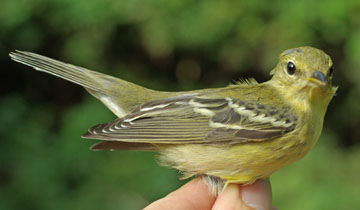
Here's a quiz bird for you to ponder:


Note heavy bill and wing bars
We had an opportunity to photograph three sparrow species: two Melospiza and one Zonotrichia genus.
Swamp, Song, and White-throated Sparrows
(Left to right)
Other highlights for the week:
Hatching Year Male
Rose-breasted Grosbeak (RBGR)

Male Red-bellied Woodpecker (RBWO)

Marsh Wren (MAWR)
Note the eye line and dark streaks on back

Another opportunity for a comparison of species. 
Here are (L-R) Winter Wren and Marsh Wren:


Winter Wren (WIWR) and Marsh Wren
Similar body size
Longer tail on the MAWR
It appears likely that the next week should bring in the final big push of October birds. Fox Sparrows (FOSP), MYWAs, and Hermit Thrushes (HETH) should be arriving in good numbers. The American Tree Sparrow (ATSP) will be the last vanguard of the fall species assemblage with its usual appearance at the end of the month.
Take time to enjoy the season!

Quiz bird answer: Pine Warbler.