Sunday, May 20, 2012

May 7th- May 13th Highlights

A busy time in the marsh region both at the research banding station and around NW Ohio.  The Biggest Week in American Birding is over but there are still birds to come. Flycatchers and vireos have not made their debut yet.

For the past four weeks the research team has had 181 banded birds returning from previous years. This is quite a significant group of birds and supports how birds home to the same area to breed each year. Something to remember when we see development in and near green spaces. There is an irreversible loss whenever habitat is taken and wildlife displaced.

A surprise this spring was this American Tree Sparrow (ATSP) which had an extended visited into early May. This is a good bird to add to any Ohio May list.

 Some other sparrows for comparison:

Take a look at these pink beaked sparrows.
White-crowned Sparrow and Field Sparrow

The weather patterns this spring have not been conducive for major pushes of birds. High pressure systems have dominated the region for most days the past couple of weeks. Diversity is here but not the volume of birds we saw last year.

We have had male Scarlet Tanagers (SCTA) singing at the research station but none have visited the banding table. However, one female came by for a quick visit. For those unfamiliar with Scarlet and Summer Tanager females, this wing flap of this Scarlet shows white axillaries while the Summer Tanager (SUTA) female shows yellow axillaries.


It is always a pleasure to have a Connecticut Warbler (CONW) visit our nets. This day we had two male CONWs and two male Mourning Warblers (MOWA).

On 13 May we were graced with many Chestnut-sided Warblers (CSWA). Twenty were banded that day and seven were caught in one net check.

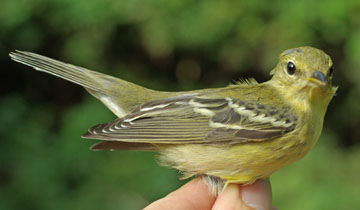
Spring is the time to enjoy the colors of birds. We catch considerably more Blackpoll Warblers (BLPW) in the fall with their differential migration path. They fly from NW Canada southeast to the mid-Atlantic coast. In the spring they fly a more northerly direction from Venezuela resulting in fewer in the region.
Take a look at this handsome male BLPW. Despite his vivid coloration, he is still a second year bird (SY). Note its primary coverts are dull brown and worn.

Another good look at both male and female BLPW.

Highlights for this time were Cape May Warbler (CMWA). 

Note the back coloration.

Orange-crowned Warbler (OCWA)

Bay-breasted Warbler male (BBWA)

And to top it off a couple females in blue:

Cerulean Warbler (CERW)


Black-throated Blue Warbler (BTBW)

Keep looking for southerly winds to create the opportunity for birds to ride north to Ohio on their way to their breeding grounds. 

Enjoy the season!

Sunday, May 6, 2012

A Few Good Birds this week in NW Ohio

The week of April 23 was not a knock out bird number wise but resulted in good opportunities to teach our new volunteers and give them one on one training. The week had good diversity but little volume due to the lake winds blowing on the beach ridge. Seven species of warblers were captured this week (Yellow (YEWA), Western Palm (WPWA), Black and White Warbler (BAWW), Myrtle Warbler (MYWA),  Black-throated Green (BTNW), Pine (PIWA), Nashville Warbler (NAWA)) and 11 species of warblers were seen/heard at the station.
Back/top view of a BTNW male
BTNW male-note facial pattern-definitive for this species

Highlights for the week were capturing a Red-headed Woodpecker (RHWO) and a banded Red-bellied Woodpecker (RBWO) in the same net. They were very vocal as these woodpeckers normally are and could be heard several nets away. The RBWO was banded in 2011 and the RHWO was banded this week as a Second Year bird (SY). Note the brown primary coverts on the RHWO.

Other highlights were a result of the cooler temps from the lake winds which brought the swallows down to lower heights in search of insects. A few found their way into our nets. This gave us an opportunity to see birds that  spend a lot more time on the wing than in the hand. Barn Swallows (BARS), Tree Swallows (TRES), and a Northern Rough-winged Swallow (NRWS).

We had a view of a "rough wing" up close and personal. Little is mentioned in the literature on the reason for the "rough wing" on this species. Some think it may be used in courtship. The leading edge of the wing has serrations and  the shape of these serrations determines the sex and age of the bird. How cool it is that?

Here is the NRWS wing.


Compared to a TRES wing.


And who can resist the close-up look at BARS?

Starting 30 April wind shifts promise for good movements. Follow the latest with Kenn Kaufman and BSBO http://cranecreekbirding.blogspot.com/ to see how migration unfolds along Ohio's Great Lake. Take time to enjoy the early season.

Sunday, November 27, 2011

Fall 2011 Highlights

The fall migration had a slow start in August and September at the Navarre Banding Station; however, by the time October rolled around, migration kicked in, and the station recorded numbers above average. This followed a record spring banding total. The tremendous effort of day-in-day out migration monitoring could not be conducted at the Navarre Marsh station without the great help and time given by the Observatory's volunteers. Thank you for all you do!
Mary Lou with her signature bird (Brown Thrasher)

The Sunday crew of Marlene, Jay, and Mark 

Deb and Julie helping at the mist net
(There is a mist net between the two ladies, but it's hard to see)
John and others like him are always fixing our equipment

The grand highlight(s) of the fall season comes with the recapture of six Blackpoll Warblers (BLPW), that we had banded in previous years. The oldest was at least six years old and still flying! Yes, at least 6 times this bird has made the trip down and back from Venezuala/Brazil to the boreal forests of Canada. The other five birds were banded in these years: 2007, 2008, 2009, 2010 (2)


BLPW- Fall Plumage

One of the greatest rewards of bird banding is learning more about their life history. BSBO's research documents that stopover habitats in the Lake Erie Marshes are important for the Blackpoll Warbler (and so many other migrant birds) each fall. This year, the weather must have been just right and a vast representative of the world Blackpoll population dropped into the small area of NW Ohio that we call home. BSBO uses this information to raise awareness of the value of stopover for migratory birds and to build local, regional, and national support for habitat conservation. If you would like to support the research and conservation efforts of Black Swamp Bird Observatory, please visit the BSBO WEBSITE for ways that you can help.

The highlight of the last day of station operations and
the feathered harbinger of winter...
American Tree Sparrow (ATSP)
With winter around the corner, just remember that spring is at the next bend. For some it is resignation, for some a welcome anticipation. But winter is a part of Ohio's seasons and there are still birds to search out and admire at your feeders or nearby parks. Some of these do not get the attention they deserve. So here they are for you to enjoy.
Male Northern Cardinal (NOCA)

White-throated Sparrow (WTSP)


Carolina Wren (CARW)


CARW back-notice long bill and distinctive eye stripe

Hermit Thrush (HETH)- a short-distance migrant. Some stay around in winter.

Take time to enjoy the birds and consider the fantastic journeys they have made and what it takes for them to make those journeys.